

BMX Race Sprockets
Maximize your acceleration and top speed with the right BMX Race Chainring. Whether you need 36T for technical tracks or 44T for the pro straight – we have the high-end aluminum parts you need. Check our gear ratio guide below to find your perfect setup.
BMX Race Sprockets FAQBMX Race Sprockets Range

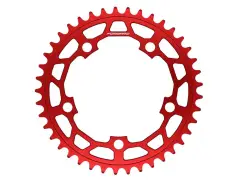


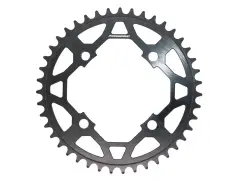



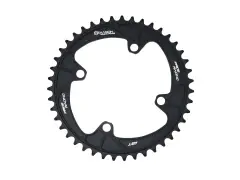
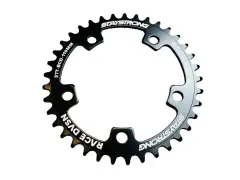
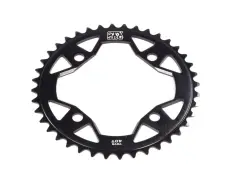
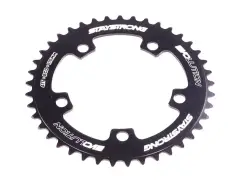

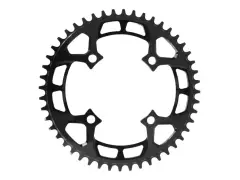
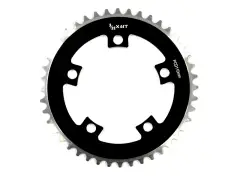
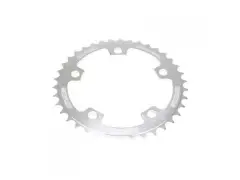
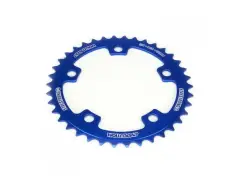
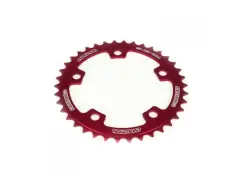
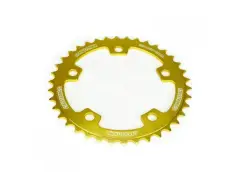

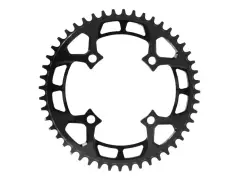

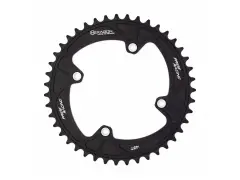
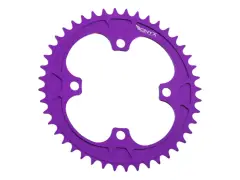
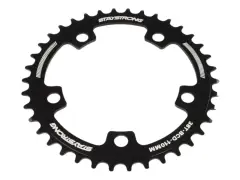
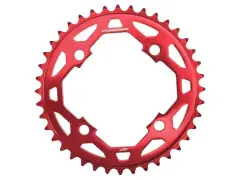
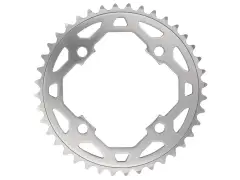
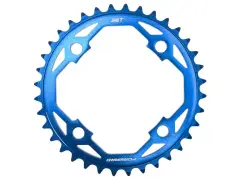


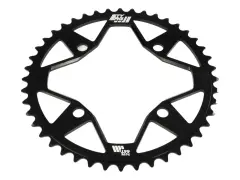
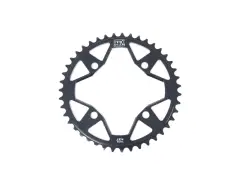


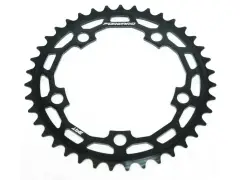
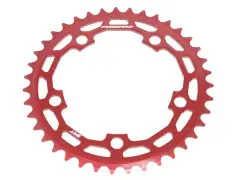
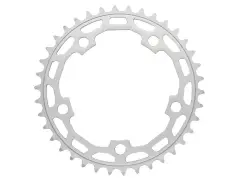


BMX Race Sprockets FAQ
What is a BMX Race Chainring and what is its main purpose?
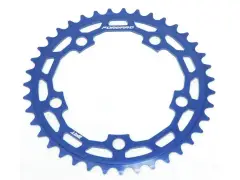
A BMX Race Chainring is the front sprocket of your drivetrain and the central component for power transmission. Unlike freestyle sprockets, race chainrings are designed for maximum stiffness and low weight to transfer every watt of your pedaling power directly into propulsion. They determine your gear ratio (translation) and thus whether you accelerate faster (short ratio) or achieve higher top speeds (long ratio).
How is a BMX Race Chainring constructed?
- Teeth
- The teeth engage with the chain. Their profile is specifically designed to hold the chain securely even during explosive starts.
- Bolt Circle Diameter (BCD)
- The mounting standard. Most race cranks use a 4-arm spider with a 104mm BCD.
- Spider Interface
- The mounting points where the chainring is screwed onto the crank arm.
What types of BMX Race Chainrings are there?
The main difference lies in the mounting and the manufacturing process:
- 4-Bolt (104mm BCD): The absolute standard in BMX racing. Compatible with almost all race cranks (Shimano DXR, Promax, Box, etc.).
- Direct Mount: Some modern cranks use chainrings that are mounted directly to the crank arm without a spider (less common in classic racing).
What materials are used for BMX Race Chainrings?
- Aluminum 6061-T6
- A widely used alloy that offers a good balance of lightness and durability.
- Aluminum 7075-T6
- The gold standard for high-end race chainrings. It is harder and stiffer than 6061, resulting in less wear and more direct power transmission.
Which BMX Race Chainring is right for my needs?
Choosing the right chainring depends heavily on your strength, the track, and your riding style. Here is a detailed guide to finding the perfect translation:
How is the gear ratio calculated in BMX Race?
The gear ratio of your BMX Race bike is crucial for your speed and acceleration. It is determined by the ratio of the teeth on your chainring (front) to those on your cog (rear). A common rule of thumb in BMX Race lies between 2.5 and 3.0. This means your chainring should have 2.5 to 3.0 times as many teeth as your cog.
Calculation Formula & Example:
Gear Ratio = Chainring Teeth / Cog Teeth Ratio = 44 / 16 = 2.75
This ratio of 2.75 is considered very balanced and is fast and efficient on many tracks.
Common Gear Ratios in BMX Race
| Chainring (Teeth) | Cog (Teeth) | Ratio | Note |
|---|---|---|---|
| 36 | 14 | 2.57 | Very short gear, for Mini-Bikes or very young/light riders on technical courses |
| 39 | 15 | 2.60 | Short gear, for Junior riders or high acceleration |
| 40 | 16 | 2.50 | For younger/lighter riders, technical tracks |
| 41 | 15 | 2.73 | Balanced, good acceleration |
| 42 | 15 | 2.80 | Standard for Expert/Intermediate, good compromise |
| 43 | 16 | 2.69 | Good compromise of power & speed |
| 44 | 16 | 2.75 | Very popular, all-rounder for most tracks (common Pro choice) |
| 44 | 15 | 2.93 | More top speed, requires more power (for strong riders) |
| 45 | 16 | 2.81 | Slightly longer gear |
| 46 | 16 | 2.88 | For high speeds on long straights |
| 48 | 17 | 2.82 | Alternative for high gears (sometimes on Cruisers) |
| 50 | 17 | 2.94 | Longer gear, often for Cruiser bikes or fast, flat tracks |
The "perfect" gear ratio is always individual. Many Pros have slightly varying setups for different tracks and weather conditions.
How do I install a BMX Race Chainring?
- Loosen the chain tension and remove the rear wheel or derail the chain.
- Unscrew the 4 chainring bolts using an appropriate tool (usually a 5mm or 6mm Innensechskant (hex key)).
- Remove the old chainring and clean the mounting surface on the crank spider.
- Place the new chainring on the spider (pay attention to the visible side/branding).
- Tighten the bolts crosswise to ensure the ring sits evenly.
- Re-mount the chain and tension it correctly.
How do I maintain and care for a BMX Race Chainring?
- Regularly check if all 4 chainring bolts are tight (torque is important!).
- Clean the teeth from dirt and oil residues to minimize wear.
- Check the teeth for "shark fins" (hooked shape) – this indicates the chainring is worn out and needs replacement.
How do I identify and fix common problems?
- Chain skips/slips: Often a sign of a worn chainring or a worn chain. Replace both if necessary.
- Creaking noises while pedaling: Often caused by loose chainring bolts. Clean the contact surfaces and retighten the bolts.
What do the specifications mean for BMX Race Chainrings?
| Specification | Explanation | Examples/Available |
|---|---|---|
| Teeth Count | Number of teeth, determines the gear ratio. | 36T, 39T, 41T, 44T, 50T |
| Material | Aluminum alloy used. | 6061-T6, 7075-T6 (High End) |
| BCD (Bolt Circle) | Diameter of the mounting holes. | 104mm (Standard), 110mm (Rare) |
| Thickness | Material thickness, relevant for chain line and stiffness. | 3mm, 4mm, 5mm |