

Pegs
Whether it's harsh grinds on the street or technical balance tricks in flatland – pegs expand your BMX with infinite possibilities. We offer not only classic steel pegs for maximum sound but also modern plastic sleeve versions, which are mandatory in many indoor parks nowadays. Find out here which peg fits your axles and which material best supports your riding style.
Pegs FAQPegs Range
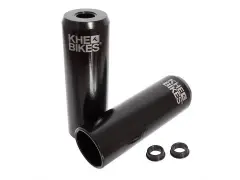
Pegs FAQ
What are pegs and what is their main purpose?
Pegs are axle extensions that allow you to grind on rails and walls (Street/Park) or perform tricks on the axles (Flatland). Depending on the discipline, they need to be either extremely slippery or particularly grippy. They are usually mounted in pairs or as a set of four on the hubs.
How is a peg constructed?
A peg is usually cylindrical, but the internal structure varies by type:
- Core
- The load-bearing part, usually made of steel or alloy, that sits directly on the axle.
- Sleeve
- A replaceable outer shell made of plastic, which ensures better sliding behavior on modern street pegs.
- Adapter
- A reducer ring that allows a 14mm peg to be used on a 10mm (3/8 inch) axle.
What types of pegs are there?
The choice of the right peg depends heavily on your intended use and the rules of your local skatepark:
- Steel Pegs (CrMo)
- The indestructible classic for street riding. They are heavier but last forever and produce the classic "clank" sound when grinding. Ideal for concrete and steel rails.
- Plastic Sleeve Pegs (PC/Alloy or PC/Steel)
- This hybrid construction consists of an inner core (alloy for weight savings or steel for stability) and a replaceable plastic sleeve. They slide significantly better on rough concrete and aluminum rails. IMPORTANT: Most indoor skateparks now strictly require these pegs to protect ramps and copings!
- Alloy Pegs
- These are extremely light but unsuitable for street grinding on steel (the material sticks/bites). However, in Flatland, they are the standard, often featuring a knurled surface for maximum grip on the shoe.
- Pure Plastic Pegs
- Solid pegs made of hard plastic without a metal core (or only with a minimal ring). They are used almost exclusively in Flatland as they are very light and offer good grip, but would not survive hard grinds for long.
What materials are used in pegs?
The material determines the sliding properties and durability:
- 4130 CrMo (Chromoly Steel)
- Extremely hard and resistant. The standard for street cores or classic pegs.
- Nylon / Polycarbonate (PC)
- A low-friction plastic for sleeves. It glides smoothly over almost everything but wears down faster than steel.
- Aluminum (6061 / 7075)
- Very light metal. Perfect as a core for sleeves or as a gripping surface in Flatland.
Which pegs are right for my needs?
When buying, pay attention to your axle diameters and your riding style:
| Discipline | Recommendation |
|---|---|
| Street / Skatepark | Choose Plastic Sleeve Pegs. They are future-proof (indoor rules), slide faster, and are lighter than solid steel pegs. |
| Hardcore Street | If you grind a lot on rough concrete and wear through sleeves too quickly, go for classic Steel Pegs. |
| Flatland | Here you need grip instead of slide. Choose Alloy Pegs with knurling or special flatland plastic pegs. |
How do I install pegs?
- Remove the axle nut from your hub.
- Place the peg (with adapter ring first, if needed) onto the axle.
- Insert a socket wrench with an extension into the peg.
- Tighten the axle nut firmly (observe the torque so the wheel doesn't shift).
- Tip: Use hubguards to protect your hub and spokes while grinding.
How do I maintain my pegs?
- Rotate street pegs regularly by a quarter turn so they wear down evenly ("Rotate your Pegs!").
- For plastic pegs: Replace the sleeves in time before the inner core rubs on the rail.
- Remove sharp burrs on metal pegs to avoid injury during falls.
What do the specifications mean?
| Term | Explanation | Examples/Available |
|---|---|---|
| Length (Inch/mm) | The length of the surface for grinding/standing. Standard lengths have increased recently. | 4.0" (100mm), 4.5" (114mm), 4.75" (120mm) |
| Axle Diameter | Fit for the hub axle. | 10mm (Front), 14mm (Rear) |
| Diameter | The thickness of the peg itself. | Standard (approx. 34-38mm), Slim (thinner), Flatland (often thicker) |